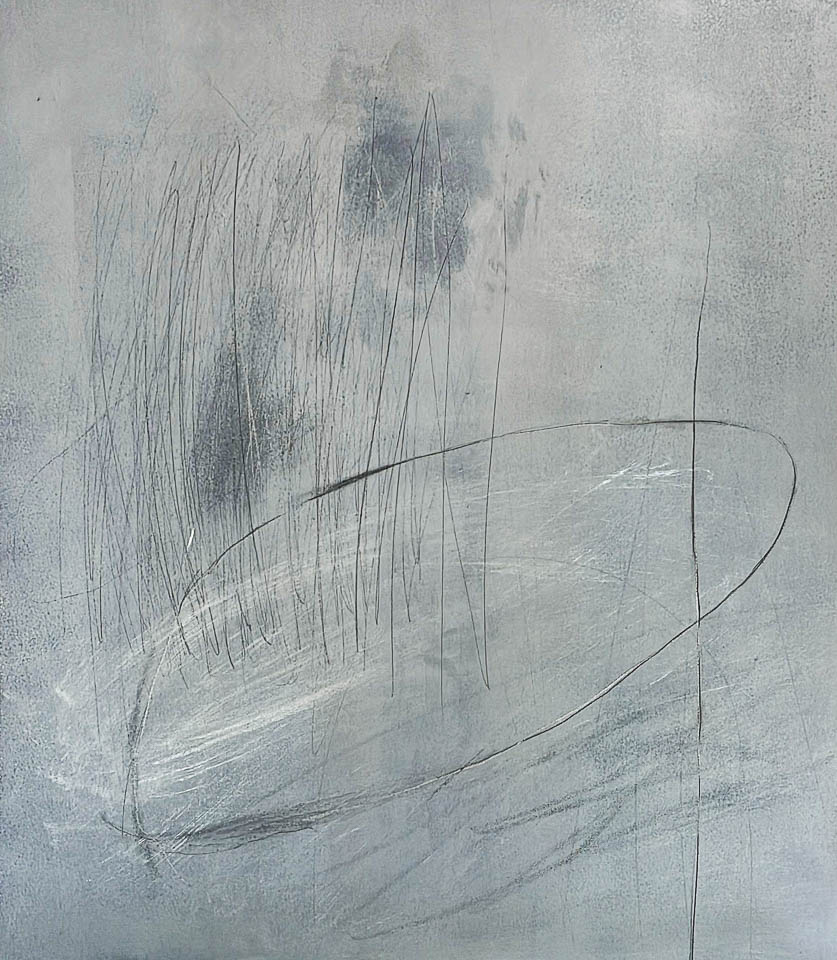
There is restraint in this work, but not silence.
The greyed surface holds space like a breath held in. To the left, a cluster of gestural lines—thin, spontaneous, yet deliberate—marks territory. They form an invisible boundary. Like the margins we live with daily. These marks are neither loud nor decorative. They are sensitive, rigorous, and quietly defiant.
A single circular line arcs across the emptiness. Almost nothing, yet it shifts everything. It is the crack in the wall. The whisper in a quiet room. It unbalances the symmetry just enough to keep the eye alert, and the mind wondering.
This is minimalism with bite.
Minimalism is making a quiet comeback. In a world saturated with visual noise and spectacle, more collectors are turning towards works that hold space rather than fill it. Works that demand presence, not performance. Untitled 9 answers that shift with clarity. It is a reminder that less is harder. That absence, when done right, carries more charge than clutter.
Sensitive work is rare. In India, even rarer. There’s too much pressure to be grand, busy, loud. Very few artists here have the guts to sit with emptiness and draw a single line that holds its own. Ritumbhra does. Her work doesn’t try to impress. It insists on being felt.
For advisors and architects, Untitled 9 offers a rare visual pause. It complements spatial clarity without disappearing. Its presence is calm but intelligent—ideal for interiors that value thought, precision, and subtle tension.
For collectors, this is early work priced with restraint. It won’t stay this accessible. Ritumbhra’s command of space and line already sets her apart. There’s honesty here. It’s the kind of work that lives with you and grows sharper over time.
Acquire it now—before the market catches up to the clarity.